
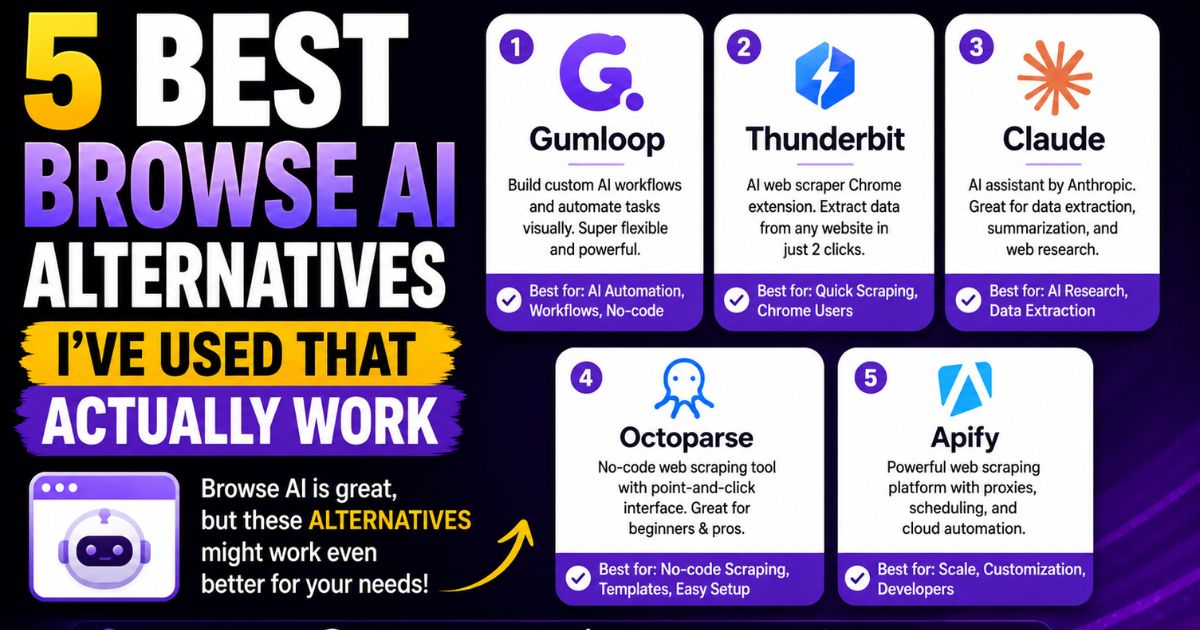
Finding the right web scraping tool isn’t easy. There are so many options out there. That’s exactly why the Browse AI alternatives I’ve used that actually work matter so much. These tools save time and actually deliver results. No fluff, no wasted hours.
After testing dozens of platforms, the Browse AI alternatives I’ve used that actually work came out on top. Each one brings something different to the table. Some are great for beginners. Others suit technical teams better. But all of them beat basic scraping hands down. Whether you need AI-powered workflows or simple lead extraction, this list covers it all. Trust the process. These picks are tried, tested and genuinely worth your attention.
What To Look For In A Browse AI Alternative
Not every web scraping tool is built the same. Before picking one, think carefully about your needs. Does it integrate with tools like Google Sheets or your CRM? Can it handle dynamic websites? Does it match your technical level? These questions matter. The right Browse AI alternative should fit your workflow naturally without extra friction.
Scaling matters too. If you need to scrape hundreds of URLs at once, you’ll want a tool that handles volume. Look for IP rotation, proxy support and scheduled scraping. Templates and AI assistants are a real bonus. They speed things up fast. A solid alternative doesn’t just collect data. It helps you actually do something useful with it.
5 Best Browse AI Alternatives And Competitors In 2026
The web scraping space has exploded in 2026. New tools keep appearing and the best ones now do far more than basic scraping. They analyze data, enrich it and push it into your existing tools automatically. That’s a genuine game changer. After deep testing, five platforms stood out clearly from the rest.
Those five are Gumloop, Thunderbit, Claude, Octoparse and Apify. Each one brings a unique strength to the table. Some are great for beginners. Others suit developers better. All of them go beyond what Browse AI offers. Whether you need AI-powered workflows or enterprise-grade scraping, this list has something that fits.
Learn more:Wordle today: Answer, hints for May 21, 2026
1. Gumloop
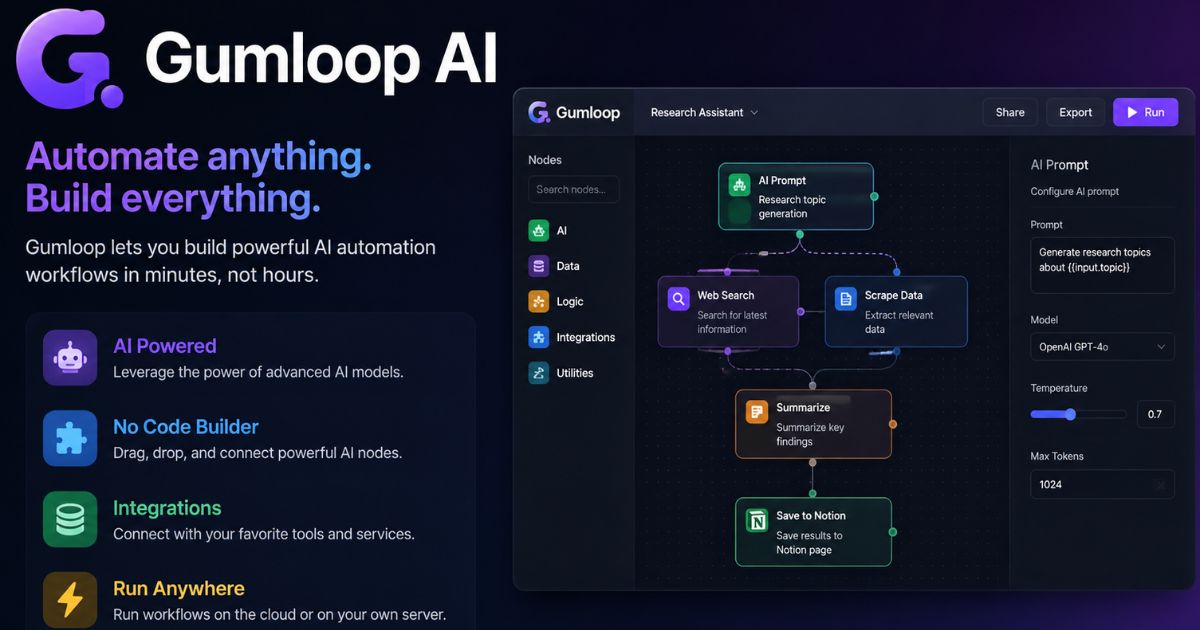
Gumloop is more than a web scraper. It’s a full AI automation platform. You can scrape data and then immediately act on it in the same workflow. That’s what makes it special. Connect it to Gmail, Slack, HubSpot or Salesforce and watch it work. It handles the whole process from start to finish.
The platform has two main features: Flows and Agents. Flows automate tasks between tools. Agents work autonomously. You simply tell them what to do. Gummie, the built-in AI assistant, helps you build workflows fast. Just describe your goal and it builds the flow for you. No coding needed at all.
How Gumloop Works
Gumloop works by connecting different tools into one automated pipeline. You pick a starting point, like a web scraper or a spreadsheet. Then you add steps. Each step does something with your data. Feed it to an LLM. Send it to your CRM. Export it to Google Sheets. The process runs automatically.
The Agents feature is where Gumloop really shines. You describe a task in plain language. The agent figures out how to complete it on its own. Ask it to scrape a competitor site and email you a weekly report. It does all that without you lifting a finger. Truly autonomous operation.
Why Choose Gumloop Over Browse AI
Browse AI focuses only on scraping. Gumloop does much more. It scrapes data and then analyzes it, enriches it and routes it to other tools in the same workflow. You don’t need separate subscriptions for LLM access either. Gumloop connects to Claude, ChatGPT and Gemini natively. That’s serious value packed into one platform.
Gummie makes building workflows approachable even for beginners. Just tell it what you want and it builds the automation for you automatically. Browse AI requires you to manually configure every single step yourself. That’s a significant difference in time and effort. For teams that want speed and flexibility, Gumloop wins easily every time.
Gumloop Pros And Cons
Gumloop has some standout strengths worth knowing. Its LLM-agnostic setup means you can connect any AI model without paying extra. The free plan is generous too. You get 2,000 credits monthly at no cost. And the web scraping capabilities are genuinely impressive when combined with AI analysis tools already inside the platform.
However, Gumloop isn’t perfect. It’s primarily an automation platform so web scraping is just one feature among many. That can feel overwhelming if scraping is all you need. The template library for scrapers is also a bit limited right now. Still, Gummie compensates for that by building custom workflows on demand.
| Pros | Cons |
| Scrapes and analyzes data in one workflow | Primarily an automation platform, not a dedicated scraper |
| LLM-agnostic — works with Claude, ChatGPT, Gemini | Web scraping templates are limited |
| Generous free plan with 2,000 monthly credits | Can feel overwhelming for simple scraping needs |
| Gummie assistant builds workflows automatically | Some features may be overkill for basic users |
Gumloop Pricing
Gumloop offers four pricing tiers. The free plan is a great starting point with 2,000 credits per month. The Solo plan at $37/month suits freelancers well. Teams get more power at $244/month with 10 seats. Enterprise pricing is custom and includes advanced security, admin controls and dedicated support for larger organizations.
Credits are the currency inside Gumloop. Every action you run uses them. Higher plans give more credits and more concurrent runs. That matters when scraping at scale. The Solo plan unlocks webhooks too. For most small teams or solo users, the free or Solo plan covers everything you’d realistically need to get started.
| Plan | Price | Key Features |
| Free | $0/month | 2,000 credits, 1 seat, 1 active trigger |
| Solo | $37/month | 10,000+ credits, unlimited triggers, webhooks |
| Team | $244/month | 60,000+ credits, 10 seats, Slack support |
| Enterprise | Custom | SCIM/SAML, audit logs, virtual private cloud |
Gumloop Ratings And Reviews
Gumloop earns strong praise across review platforms. Users consistently highlight how easy it is to build complex workflows without technical knowledge. The Gummie assistant gets special mentions for making automation feel effortless. Many reviewers say it replaced multiple tools they were paying for separately. That’s a strong sign of genuine value.
The ratings speak for themselves. Product Hunt gives it a perfect 5/5 from over 12 reviews. There’s An AI For That also rates it 5/5. These scores are rare in the tools space. Most platforms struggle to maintain consistency. Gumloop manages to impress both beginners and experienced automation builders alike.
| Platform | Rating | Reviews |
| Product Hunt | 5/5 | 12+ reviews |
| There’s An AI For That | 5/5 | 1+ review |
2. Thunderbit
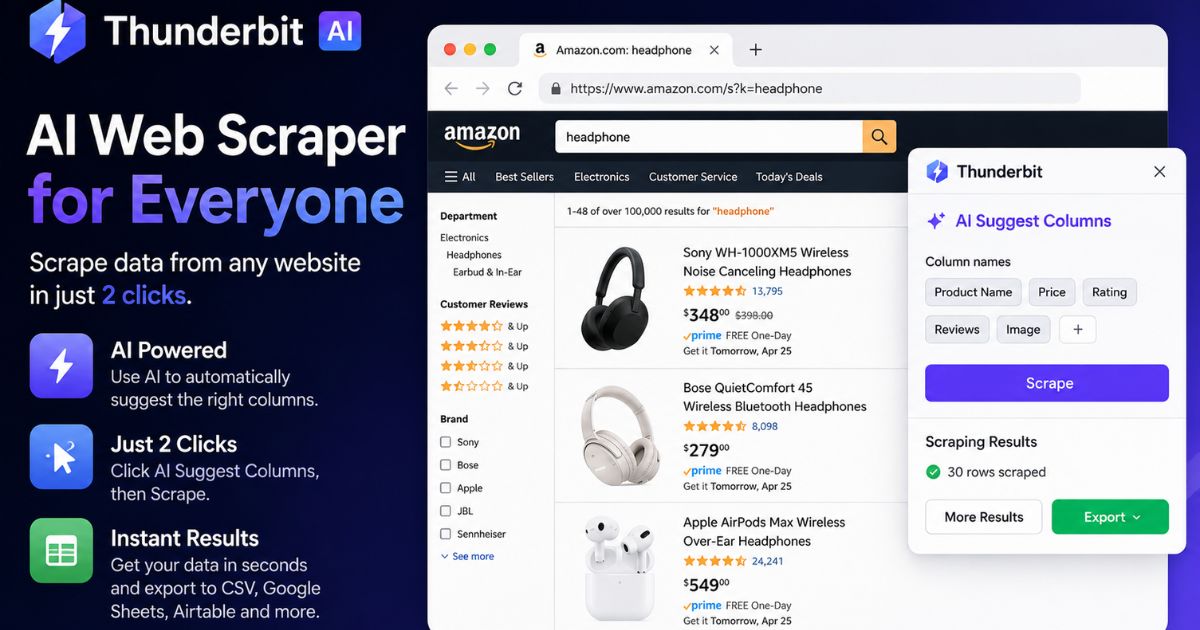
Thunderbit takes a refreshingly simple approach to web scraping. It lives right inside your Chrome browser as an extension. No separate dashboards. No complex setups. Sales and operations teams love it because it puts scraping power exactly where they already work. Just open a website and start extracting data immediately.
What sets Thunderbit apart is its AI-powered data structuring. You don’t manually map fields at all. The AI figures out how to organize the information for you. It even handles PDFs and images. For sales teams hunting leads on LinkedIn, Zillow or Amazon, Thunderbit delivers structured data fast and without friction.
How Thunderbit Works
Install the Thunderbit Chrome extension and you’re ready to go. Navigate to any website you want to scrape. Thunderbit’s AI scans the page and suggests how to extract the data. Use natural language to describe what you want. The tool structures it into clean tables automatically. No coding required at any step.
Thunderbit also handles subpage scraping. That means it can follow links and pull additional data from inner pages. It appends that enriched data into your existing tables. Export everything to Google Sheets, Notion or Airtable with one click. For sales teams building lead lists fast, this feature alone makes Thunderbit worth trying.
Why Choose Thunderbit Over Browse AI
Thunderbit wins on simplicity and speed. Browse AI requires you to train robots and configure workflows step by step. Thunderbit skips all that. You open the extension, describe what you want and get results fast. It also has pre-built templates for popular platforms like LinkedIn, Amazon and Glassdoor. Setup takes minutes not hours.
Pricing is another major win. Browse AI’s starter plan runs $48/month. Thunderbit starts at just $15/month. For solo users or small teams, that’s a meaningful saving. The built-in data enrichment features also suit sales workflows far better than Browse AI does. More value at a lower price point is hard to ignore.
Thunderbit Pros And Cons
Thunderbit’s biggest strength is accessibility. Anyone can use it without technical knowledge. The pre-built templates for LinkedIn, Twitter, Zillow, TikTok and Amazon save serious time. Built-in lead enrichment makes it perfect for sales teams. And exporting to Google Sheets or Airtable is completely seamless. Getting started literally takes under five minutes.
The downsides are real though. Thunderbit isn’t as flexible as platforms like Gumloop for complex edge cases. You’re fully dependent on Chrome which limits where you can use it. The credit system can also confuse new users. And if you need a heavy-duty scraper for enterprise-level volumes, Thunderbit will likely fall short.
| Pros | Cons |
| Dead simple Chrome extension setup | Locked into Chrome browser |
| Pre-built templates for major platforms | Less flexible for complex use cases |
| Great for lead gen and sales teams | Credit system can be confusing |
| Affordable starting price at $15/month | Not built for enterprise-scale scraping |
Thunderbit Pricing
Thunderbit keeps pricing accessible. The free plan gives 6 pages per month which is enough to properly test the tool. The Starter plan at $15/month (or $9/month billed annually) unlocks 500 credits and key features like subpage scraping and bulk scraping. It’s a solid entry point for individuals and small teams.
The Pro plan at $38/month jumps to 3,000 credits and adds scheduled scraping with monitoring as frequent as every 5 minutes. For sales teams that need real-time data updates, that’s a genuinely powerful feature. Business pricing is custom and includes dedicated support plus flexible credit limits suited to larger organizations.
| Plan | Price | Key Features |
| Free | $0/month | 6 pages/month, basic data extraction |
| Starter | $15/month ($9 annual) | 500 credits, subpage & bulk scraping |
| Pro | $38/month | 3,000 credits, scheduled scraping, 25 scrapers |
| Business | Custom | Custom credits, priority support |
Thunderbit Ratings And Reviews
Thunderbit has built real trust with its user base. On the Chrome Web Store it holds a 4.4/5 rating from over 115 reviews. That’s a strong score for an extension in a competitive market. Users consistently praise how fast and intuitive it is to set up. Most say they had it running within minutes.
Trustpilot tells a similar story with a 4.3/5 score from 29 reviews. Sales professionals make up a big portion of reviewers. They highlight the lead scraping and enrichment features most. A few reviews mention the credit system being slightly confusing. Overall though, sentiment stays positive and the tool earns its reputation.
| Platform | Rating | Reviews |
| Trustpilot | 4.3/5 | 29+ reviews |
| Chrome Web Store | 4.4/5 | 115+ reviews |
3. Claude

Claude is arguably the most versatile AI tool on this list. At its core it’s a powerful large language model built for business tasks. But its web agent changes everything for scraping. You don’t configure anything. You just talk to Claude and tell it what you want. It figures out the rest.
Beyond scraping, Claude can write code, analyze data, create content and reason through complex tasks. Its large context window means you can feed it huge datasets and it still understands everything. Pair it with MCP connectors and it integrates with tools across your entire tech stack. It’s a true all-in-one AI assistant.
How Claude Works
Claude works through a simple chat interface. You type a request in plain English and Claude acts on it. For web scraping, give it a URL or sitemap and describe what you need. It fetches the page, reads the content and gives you structured insights. No training robots. No complex configuration. Just conversation.
For deeper workflows, combine Claude with tools like Gumloop or use Claude MCP to connect to external platforms. Claude Computer Use even lets it make direct edits to files on your computer based on scraped insights. It’s available on iOS, Android, desktop and web so you can work from absolutely anywhere.
Why Choose Claude Over Browse AI
Claude beats Browse AI on ease of use. There’s zero setup. No training. No configuration. You talk to it naturally and it does the work. Browse AI requires you to build robots and define scraping workflows upfront. Claude figures that out for itself. For one-off scraping tasks, nothing comes close to Claude’s simplicity.
Claude also interprets data as it scrapes. Browse AI pulls raw information and hands it to you. Claude analyzes what it finds and gives you actionable insights in the same response. Its large context window handles entire sitemaps in one go. For smart, context-aware scraping, Claude delivers in a way Browse AI simply doesn’t.
Claude Pros And Cons
Claude’s strengths are hard to overlook. It’s the easiest tool on this list to use. Zero setup means zero frustration. The large context window handles massive datasets with ease. Its built-in web search and reasoning agent make it feel like a proper AI research partner. Most users are productive within their very first session.
The limitations are real though. Claude isn’t a dedicated web scraper so advanced scraping features are missing. It works best for single pages or sitemaps, not long lists of URLs from a spreadsheet. Rate limits on lower-tier plans can also slow you down. If bulk scraping is your goal, another tool fits better.
| Pros | Cons |
| Zero setup — just talk to it | Not a dedicated web scraper |
| Massive context window for large datasets | Limited for bulk URL list scraping |
| Built-in web search and reasoning agent | Rate limits on lower-tier plans |
| Works on web, iOS, Android and desktop | Best for ad-hoc tasks, not ongoing scraping |
Claude Pricing
Claude’s free plan is genuinely generous. You get web search, image analysis, code generation and access across all platforms at no cost. The Pro plan runs $20/month (or $17/month billed annually). That unlocks more usage, Claude Code, Research mode, extended thinking, Google Workspace integration and access to more powerful Claude models.
The Max plan starts at $100/person per month. It gives 5x or 20x more usage than Pro plus memory across conversations and priority access during high traffic. There’s also Claude in Excel for spreadsheet work. For power users who rely on Claude daily for complex tasks, Max is worth every dollar.
| Plan | Price | Key Features |
| Free | $0/month | Web search, image analysis, code generation |
| Pro | $20/month ($17 annual) | More usage, Claude Code, Research, MCP connectors |
| Max | From $100/month | 5x–20x usage, memory, priority access, Claude in Excel |
Claude Ratings And Reviews
Claude earns consistently strong reviews from users across different industries. On G2 it holds a 4.4/5 rating from 89 reviews. Capterra users rate it even higher at 4.6/5 from 28 reviews. Professionals praise its ability to understand complex requests and deliver thoughtful, accurate responses. Writers, developers and marketers all find it genuinely useful.
Common praise centers on Claude’s conversational depth and contextual understanding. Users say it outperforms other AI tools for nuanced reasoning tasks. The main criticism is around usage limits on the free plan. Some power users want even higher output limits. Overall, Claude stands out as one of the highest-rated AI assistants available today.
| Platform | Rating | Reviews |
| G2 | 4.4/5 | 89+ reviews |
| Capterra | 4.6/5 | 28+ reviews |
4. Octoparse
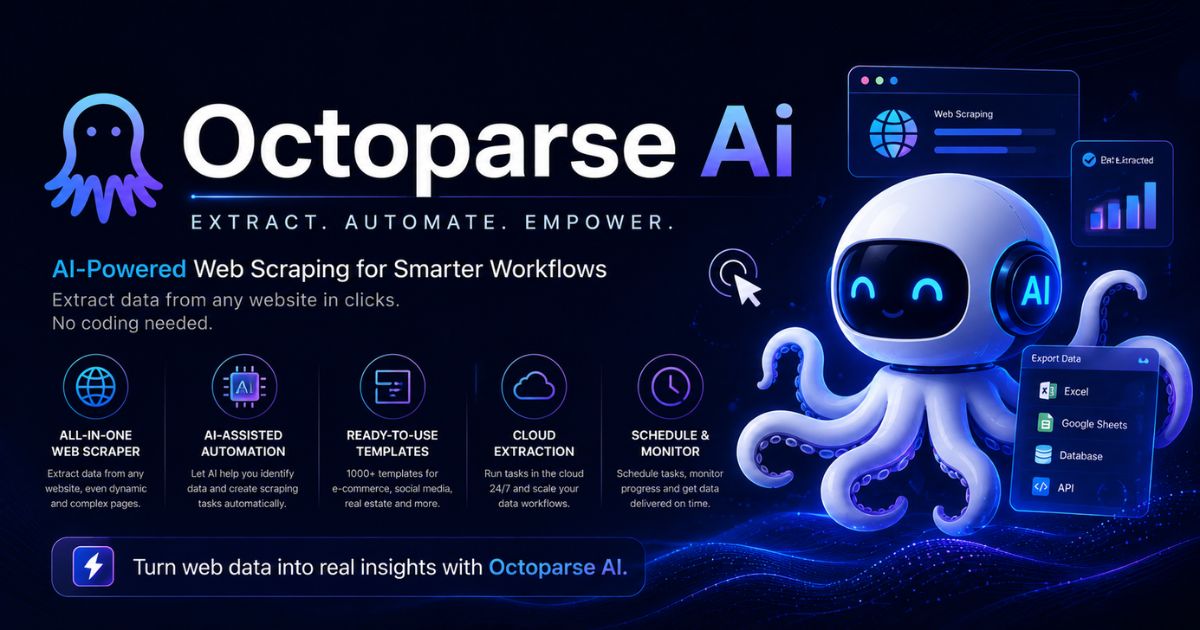
Octoparse is a no-code web scraping tool with serious depth. It’s been around for years and counts brands like Sony, Honda and Audi among its customers. That says a lot about its reliability. It’s not the simplest tool to learn but it gives you granular control over every part of your scraping workflow.
Think of Octoparse as the tool for teams that want maximum scraping power without writing code. CAPTCHA solving, IP rotation, scheduled scrapes and automatic exports all come built in. There’s also a solid template library with scrapers for Google, Amazon, Google Maps and more. It’s a heavy-duty tool built for serious data extraction.
How Octoparse Works
Start by pasting a URL into Octoparse. The AI scans the page automatically. From there you build a workflow by selecting the elements you want to extract. It’s visual and click-based so you don’t need to touch code. The platform trains the scraper based on your selections and then runs it on a schedule.
Where Octoparse really excels is in handling complex web interactions. It can log into websites, fill out forms and navigate multi-step pages. Advanced users can also work with XPath and regex for precision scraping. Scraped data exports directly to databases, Google Sheets, Dropbox or via API. Everything happens inside Octoparse’s cloud infrastructure.
Why Choose Octoparse Over Browse AI
Octoparse gives you far more control than Browse AI. Its visual workflow builder lets you define exactly which elements to scrape and how to interact with the page. Browse AI leans heavily on AI to figure that out. Octoparse lets you be precise. For technical teams scraping complex or heavily structured websites, that precision matters enormously.
Scale is another big advantage. Octoparse supports up to 40 concurrent cloud processes on its Enterprise plan. It handles IP rotation and CAPTCHA solving natively too. Browse AI doesn’t match that level of infrastructure. For teams scraping thousands of pages consistently, Octoparse is simply the more dependable and scalable choice hands down.
Octoparse Pros And Cons
Octoparse packs in serious scraping capabilities. Its no-code builder handles complex interactions like logins, form fills and multi-step navigation with ease. XPath and regex support give power users full flexibility. The template library covers dozens of popular platforms. And IP rotation plus CAPTCHA solving mean fewer blocked requests when scraping at volume.
The learning curve is the biggest drawback. Non-technical users often feel overwhelmed by the interface. Bugs can surface too and fixing them without engineering knowledge gets frustrating fast. Pricing also starts at $83/month which is steep for individuals or small teams. If you only need light scraping, Octoparse is likely overkill.
| Pros | Cons |
| Handles logins, forms, and multi-step pages | Steep learning curve for beginners |
| XPath, regex, and advanced scraping features | Can surface technical bugs |
| IP rotation and CAPTCHA solving built in | Paid plans start at $83/month |
| Large template library for popular sites | Overkill for light scraping needs |
Octoparse Pricing
Octoparse offers a free desktop plan with 10 tasks and up to 50,000 data exports per month. The Standard plan at $83/month unlocks cloud scraping with 100 tasks, IP rotation, CAPTCHA solving and 500+ templates. It supports up to 3 concurrent cloud processes which suits most small to medium-sized teams comfortably.
Scaling up, the Professional plan at $299/month adds 250 tasks and 20 concurrent cloud processes. Data saves directly to Google Sheets, Drive, Dropbox and S3. You also get 1-on-1 training and dedicated priority support. Enterprise pricing is custom and includes 750+ tasks, 40+ concurrent processes and a dedicated success manager.
| Plan | Price | Key Features |
| Free | $0/month | Desktop app, 10 tasks, 50K exports/month |
| Standard | $83/month | 100 tasks, cloud scraping, IP rotation, CAPTCHA |
| Professional | $299/month | 250 tasks, 20 cloud processes, Google Sheets export |
| Enterprise | Custom | 750+ tasks, 40+ processes, dedicated manager |
Octoparse Ratings And Reviews
Octoparse earns impressive scores from its users. On G2 it holds a 4.8/5 rating from over 52 reviews. Capterra users rate it 4.7/5 from 106 reviews. Those are strong numbers for a platform in a highly competitive space. Reviewers consistently highlight the depth of features and the reliability of the cloud infrastructure.
The most common criticism in reviews is the learning curve. New users say it takes time to fully understand the platform. Technical bugs also get mentioned occasionally. But most reviewers agree the payoff is worth it once you get past the initial setup phase. Long-term users tend to rate it very highly.
| Platform | Rating | Reviews |
| G2 | 4.8/5 | 52+ reviews |
| Capterra | 4.7/5 | 106+ reviews |
5. Apify
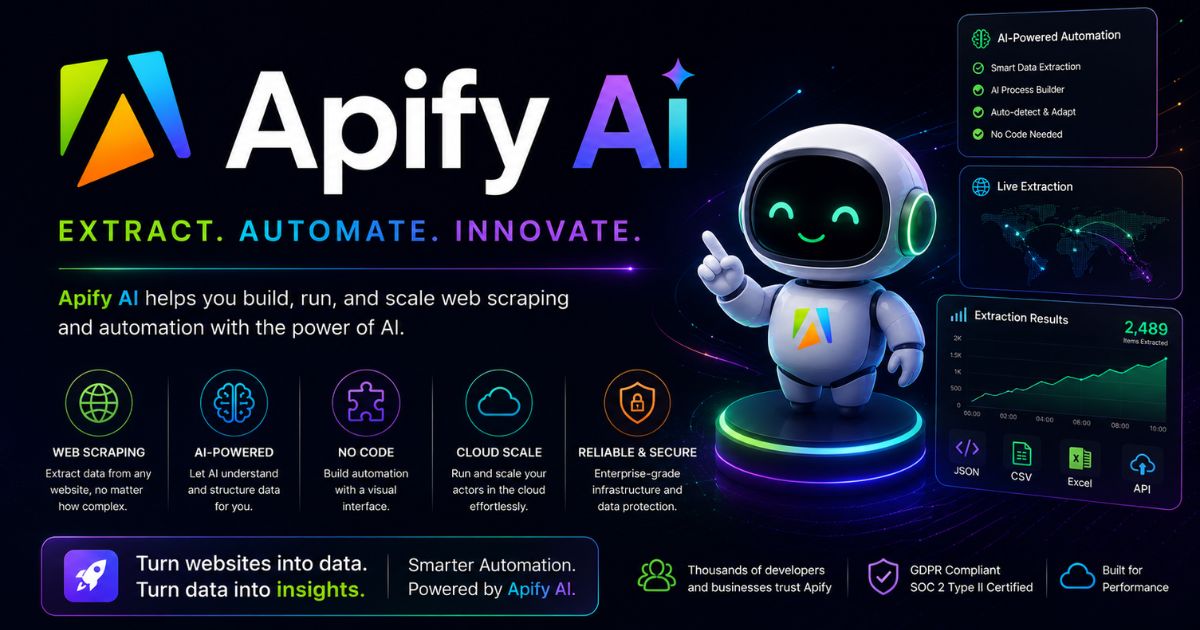
Apify is the enterprise-grade option on this list. Big names like T-Mobile, Square and Intercom trust it for large-scale web scraping. It’s cloud-native and genuinely built to handle serious volume. If you need a scraper that scales without breaking a sweat, Apify is the platform purpose-built for exactly that challenge.
What makes Apify unique is its Actor marketplace. It hosts over 10,000 pre-built scraping apps. These Actors cover everything from Instagram and TikTok to Google Maps and web browsers. You can use existing Actors or build your own with custom code. Developers especially love how much control and flexibility the platform provides.
How Apify Works
Apify runs on a concept called Actors. Each Actor is a serverless scraping app that you run in the cloud. Browse the marketplace for a pre-built Actor that suits your needs or build one from scratch using JavaScript or Python. Actors accept custom inputs and run on a scheduled basis or via API triggers.
Scraped data lands in Apify’s cloud storage as structured datasets. Export them as CSV, HTML, JSON or Excel. You can also connect directly to Slack, Google Sheets, Zapier or any platform via webhook or API. For teams building LLM pipelines or RAG systems, Apify’s website content crawler formats output specifically for AI consumption.
Why Choose Apify Over Browse AI
Apify outclasses Browse AI when it comes to enterprise scale. It’s SOC2 and GDPR compliant which matters for large organizations handling sensitive data. Browse AI doesn’t offer that level of security assurance. Apify also manages proxies, IP rotation and cloud infrastructure automatically. You focus on the data. Apify handles the heavy infrastructure lifting.
The Actor marketplace is another massive advantage. Over 10,000 pre-built scrapers means you rarely need to build from scratch. Browse AI’s template selection is far more limited by comparison. Apify also integrates deeply with developer tools like GitHub and supports both JavaScript and Python SDKs. It’s simply built at a different level.
Apify Pros And Cons
Apify’s strengths are undeniable for enterprise users. Its marketplace of 10,000+ Actors is unlike anything else in the market. Cloud-native infrastructure means proxy management, IP rotation and storage are all handled for you. The website content crawler even prepares scraped data specifically for LLM and RAG pipeline integration. That’s rare and highly valuable.
The downsides surface mostly for smaller teams. There’s a noticeable learning curve especially if you want to customize Actors. Non-developers may struggle to navigate the platform confidently. Apify’s pay-as-you-go model can also add up quickly at scale. If you just need occasional scraping, the cost and complexity aren’t worth it.
| Pros | Cons |
| 10,000+ pre-built Actors in marketplace | Steep learning curve for beginners |
| SOC2 and GDPR compliant | Pay-as-you-go can get expensive |
| Cloud-native with proxy and IP management | Non-developers may find it complex |
| LLM and RAG-ready content crawler | Overkill for occasional scraping |
Apify Pricing
Apify uses a credit-based pay-as-you-go pricing model. The free plan gives you $5 to spend in the Actor marketplace. The Starter plan at $39/month includes $39 in store credits and chat support. Compute units run at $0.30 each on both plans. Bronze-level Actor Store discounts also apply on the Starter plan.
The Scale plan at $199/month drops compute costs to $0.25 per unit and adds priority support. Business at $999/month brings compute down further to $0.20 and includes a dedicated account manager. Custom plans come with SLAs, guaranteed data delivery and a full expert team. Large enterprises get the full white-glove treatment.
| Plan | Price | Compute Rate | Key Features |
| Free | $0/month | $0.30/unit | $5 store credit |
| Starter | $39/month | $0.30/unit | Chat support, Bronze discount |
| Scale | $199/month | $0.25/unit | Priority support, Silver discount |
| Business | $999/month | $0.20/unit | Account manager, Gold discount |
| Custom | Custom | Custom | SLAs, dedicated expert team |
Apify Ratings And Reviews
Apify has built an outstanding reputation in the web scraping community. On G2 it earns a 4.7/5 from over 333 reviews. That’s a large sample size and a strong score to maintain consistently. Capterra rates it even higher at 4.8/5 from 378 reviews. Few platforms in this category match those numbers at that volume.
Developer teams praise the Actor marketplace most. The flexibility to build and customize scrapers in JavaScript or Python gets frequent mention. Reliability and scalability are also recurring highlights. Some users note the pricing can climb fast on pay-as-you-go. Overall though, Apify’s reviews paint a picture of a platform that consistently delivers at scale.
| Platform | Rating | Reviews |
| G2 | 4.7/5 | 333+ reviews |
| Capterra | 4.8/5 | 378+ reviews |
What Is The Best Alternative To Browse AI
The honest answer is it depends entirely on your use case. For full AI-powered workflows, Gumloop wins hands down. For quick, zero-setup scraping, Claude is unbeatable. Sales teams scraping leads will love Thunderbit. Technical teams needing precision and control should look at Octoparse. And enterprises needing serious scale go straight to Apify.
For most people, start with Gumloop or Claude. Both have free plans so there’s nothing to lose. Gumloop handles end-to-end automation beautifully. Claude handles one-off scraping with zero friction. Either way, you’ll quickly see why these tools have left Browse AI behind. The scraping space has evolved and these picks reflect that perfectly.
FAQ’S
What are the best Browse AI alternatives available right now?
The top Browse AI alternatives are Gumloop, Thunderbit, Claude, Octoparse and Apify. Each one offers unique features that go beyond basic web scraping capabilities.
Which Browse AI alternative is easiest for beginners?
Claude is the easiest option hands down. Just type what you need and it handles everything. Zero setup, zero configuration and zero technical knowledge required.
Which Browse AI alternative works best for sales teams?
Thunderbit is perfect for sales teams. It’s a simple Chrome extension that scrapes leads from LinkedIn, Amazon and Zillow fast and exports data instantly.
Are there any free Browse AI alternatives worth trying?
Yes, absolutely. Gumloop, Thunderbit, Claude, Octoparse and Apify all offer free plans. You can test each one without spending a single dollar upfront.
Which Browse AI alternative handles large-scale enterprise scraping best?
Apify is built for enterprise scale. It’s SOC2 compliant, cloud-native and offers over ten thousand pre-built scraping apps inside its massive Actor marketplace.
Conclusion
Choosing the right Browse AI alternatives doesn’t have to be hard. Each tool on this list solves a real problem. Gumloop handles full workflows. Claude keeps things simple. Thunderbit suits sales teams perfectly. The best Browse AI alternatives depend entirely on what you need most right now.
Don’t overthink it. Start with a free plan and test things yourself. The Browse AI alternatives covered here are genuinely worth your time. They’re faster, smarter and more flexible than ever before. Pick one that fits your workflow and get started today. Better scraping results are closer than you think.